Search for a house painter and you will find two kinds of websites. One kind is a brochure: a stock photo of a roller, a paragraph about "quality and attention to detail", and a contact form that says nothing about what happens after you press send. The other kind answers the three questions a homeowner is actually asking: what do you paint, what does it cost, and will it still look right in five years. The second kind gets the estimate request.
This guide is about the second kind. It covers what those sites have in common, walks through one published example section by section, and lays out what each way of getting a site built will cost you in money and in your own time.
What the painting contractor websites that win estimates have in common
Painting is bought deliberately. Nobody is standing in an inch of water; the homeowner is collecting two or three bids, on a phone, over a week or two, and choosing the company that seems least likely to leave a mess and most likely to still be answering the phone when the trim peels. That changes what a good website is. The sites that convert share seven habits.
1. The work shown is yours
A painting company sells a finish, and a finish is visible. Photographs of jobs you completed, ideally with the "before" alongside, are the strongest thing on the page. Stock photography of a stranger's living room signals a template; a photo of a west elevation you repainted last spring signals a company that exists. If you have no photographs yet, a plain page with none is better than a page full of somebody else's house.
2. Interior, exterior, cabinets and commercial are separated
A homeowner with a kitchen to refinish does not want to read about exterior siding, and a landlord turning rental units wants to know you do that at all. Name each kind of work in its own section, with what the job includes. This also matches how people search: "cabinet painters near me" and "exterior house painters" are different queries, and one page that names both in text can appear for both.
3. The prep is explained, because that is what they are paying for
Two bids for the same house can differ by thousands of dollars and both say "two coats". The difference is washing, scraping, sanding, caulking and priming. A site that says what its prep includes, in plain words, gives the homeowner a reason the higher number is the safer one. A site that says only "quality workmanship" leaves them to choose on price.
4. The estimate request says what happens next
"Request a quote" is a button, not a promise. The sites that win say how the estimate works: whether someone visits, how long it takes, when the written number arrives, and whether there is any pressure to sign on the spot. A homeowner who knows the visit takes thirty minutes and the estimate comes in writing within two days will book it; one who suspects a sales pitch in the kitchen will not.
5. The service area is written out, and the calendar is honest
Name the cities and neighborhoods you actually drive to. That text is what lets your site appear when someone searches for a painter in their own town. If exterior work stops in the cold months where you are, say so with the months; a visitor who learns that from you in September trusts you more than one who learns it from your voicemail.
6. Licence, insurance and warranty are visible without being asked
Painters are on ladders against somebody's house. Your licence number where your state issues one, your insurance status, and your warranty terms belong on the page in plain text, near the top. This is the cheapest trust signal you have, and the sites that bury it in an "about" subpage give up that advantage for nothing.
7. It loads fast on a phone
Full-screen slideshows, autoplaying video, and a chat widget that loads before the content all cost seconds on a mobile connection, and a gallery of twenty uncompressed photos costs more. A painting site does need pictures, so the discipline is in the count and the file size, not in leaving them out. Six good photographs that load in a second beat forty that make the page crawl.
The test is simple. Open your site on a phone and try to answer, in under a minute, what you paint, what it roughly costs, how the estimate works, and whether you are insured. Any question a visitor cannot answer from the page, they will answer by calling the next listing.
One published example, section by section
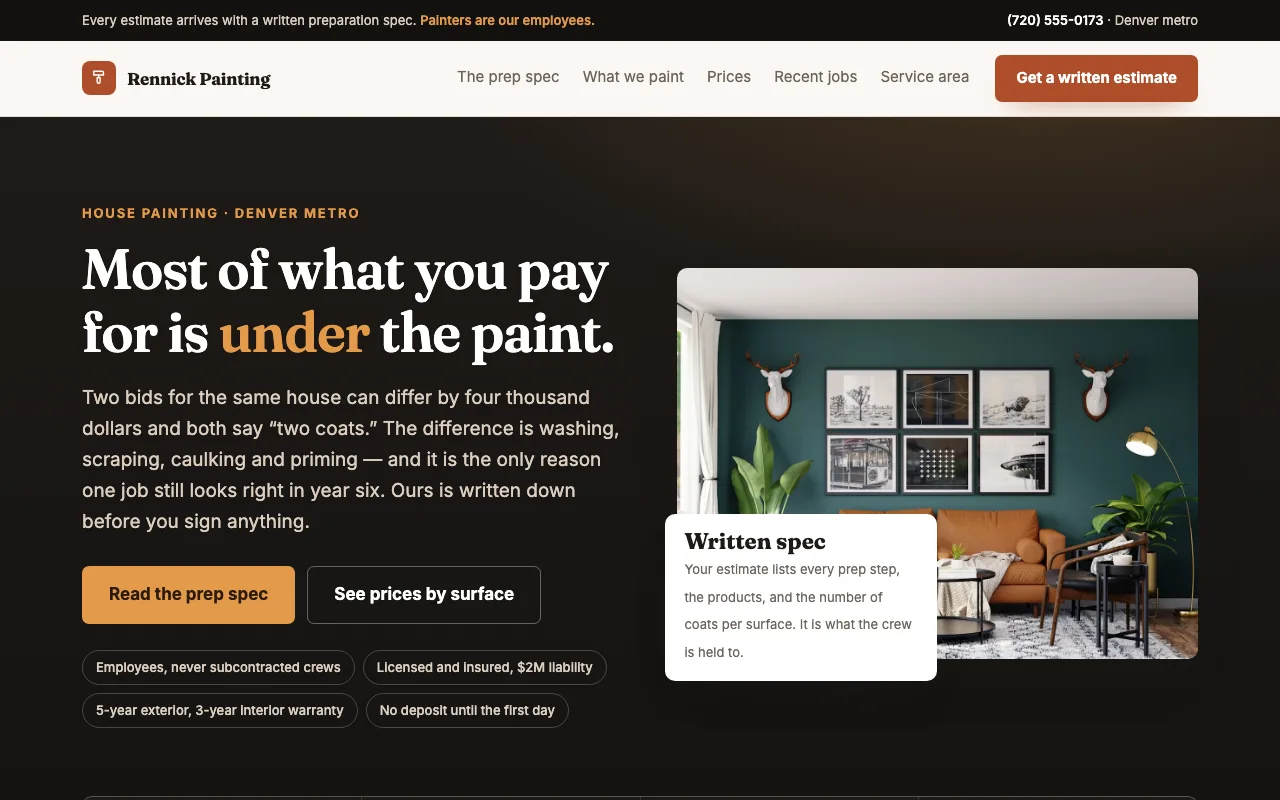
The Rennick Painting Co. site linked below is a demonstration published on FyneSite. It is not a customer's business, and it is useful here because it shows most of the habits above in a real page rather than a checklist. It also shows what no demonstration can supply: the photographs are stock placeholders, and every specific on it (starting prices by surface, the "$2M liability" insurance line, the "5-year exterior, 3-year interior" warranty, the customer quotes, the four job write-ups, the crew count and the towns served) is sample copy written for the showcase. None of it is a rate card or a promise you can reuse. All of it is yours to replace before you publish.
- Hero. One line, "Most of what you pay for is under the paint", and two actions: read the prep spec, or see prices by surface. A summary strip underneath names the trust facts a homeowner looks for (who does the work, insurance, warranty, deposit terms), which is where a real company puts its real ones.
- The prep spec. Four steps in order: wash and let it dry, scrape and sand to a sound edge, caulk and prime what is open, two coats sprayed and back-rolled. Then a two-column comparison of what is in the written spec against what usually comes out of a low bid. This is habit 3 done as a page section instead of a sentence.
- Four kinds of work. Interior walls, ceilings and trim; exterior siding, trim and soffit; cabinet refinishing; small commercial and rentals. Each with its own short description, so each can be found on its own.
- Prices by surface. A table of starting prices with a note that a written estimate confirms the number against the actual walls. The figures are sample numbers; the pattern, publishing a starting price and saying what it includes, is the part worth copying.
- Four jobs. Short write-ups of what each house needed and why, standing in for the real before-and-after gallery a company would have.
- Service area and calendar. A named list of Denver-metro towns, a plain statement of where the company will say no, and a table of what can be painted in which months.
- Reviews and process. Three sample quotes, then "Four steps, and you can stop after any of them": tell us the surfaces, we walk it with you, you get it in writing, you pick a start date. That is habit 4, and it removes the fear of a kitchen-table sales pitch before it forms.
- Closing action. "Get a written estimate", with the phone number repeated. The page carries six tap-to-call links and two email links, so a homeowner is never more than one thumb away from either.
What the example does not have is also worth noticing: no slideshow, no video background, no popup. What it still needs from an owner is everything a demonstration cannot know: your own photographs in place of the placeholders, your real starting prices or none, your licence number where your state issues one, your actual insurance and warranty terms, and reviews from people who hired you. Publish nothing about price, coverage, credentials or guarantees that is not true of your company.
What a painting contractor website costs, by the way you get it
There are three common ways to end up with a painting website. They differ less in the finished page than in what they ask of you and who owns changes afterwards.
| Path | What you pay for | What it asks of you | Who changes it later |
|---|---|---|---|
| Freelancer or agency | A one-time build, sometimes plus a maintenance retainer | Briefing, feedback rounds, supplying photos and copy, waiting for delivery | Depends on the handover: you, if they leave you an editable site and show you how; otherwise the builder, by request |
| Done-for-you subscription | A monthly fee, often with a setup charge, for a site someone else assembles from your details | A questionnaire and a launch wait | Their support team, by request |
| AI website builder (FyneSite) | A draft generated from your description; free to publish on a FyneSite address, paid for a custom domain and branding removal. Other builders set their own publishing terms, some paid | Describing your services and area, then reviewing the draft and adding your photographs | You, in plain English, whenever the prices, the season or the services change |
The question to ask of any path is not the headline price but the cost of the next change. Painting companies add cabinet work, raise a starting price, close exterior bookings for the winter, and post the photographs from last month's job. Whatever path you take, make sure you know before you sign who can add a photo to the gallery, and what that costs.
FyneSite is the third path. You describe the work you do and the towns you serve, review an editable draft, and publish free on a FyneSite address. A paid plan adds your own domain and removes FyneSite branding; current prices are on the pricing page.
Before you publish: a ten-minute checklist
- Count the photographs that are yours. If the answer is zero, take six on a phone at the next job and replace the placeholders before anything else.
- Read the service list aloud. Interior, exterior, cabinets, commercial: each kind of work you want more of should have its own heading in text.
- Find your licence number and insurance line. If it takes more than one scroll, move it up.
- Check the estimate copy against what you actually do. If the page says a visit takes thirty minutes and the number arrives in two days, that has to be true.
- Check the season. If exterior work stops for the winter where you are, the page should say so before a visitor asks in November.
- Match the number to your listings. The phone number on the page should be the same one on your Google Business Profile and directory listings, so a customer who sees both is not confused. (Seeing the site in search results is a check for after publishing; a new page can take days or weeks to appear.)
Everything on this list is a content decision, not a design decision. That is the point: a painting contractor website wins estimates by showing real work and explaining what the price buys, and both of those are within reach of any company that can describe its own jobs.