HomeBlog

Do I Need a Website for My Real Estate Business in 2026?

Published April 12, 2026 · 8 min read

Here is a number that should concern every agent without a website: 27% of small businesses in the United States still do not have a website. In real estate, where 97% of homebuyers start their search online, that gap is not just a missed opportunity. It is money walking out the door every single day.

If you are a real estate agent asking whether you really need your own website in 2026, the short answer is yes. The longer answer explains why it matters more now than ever, what it actually costs, and why the old excuses no longer hold up.

The Numbers Tell the Story

The National Association of Realtors reports that 97% of homebuyers used the internet during their home search in 2025. That is not a trend. It is the default behavior of every serious buyer and seller in the market.

Yet most agents rely on their brokerage website, a Zillow profile, or social media as their only web presence. The problem? None of those give you control. On Zillow, your listing appears next to three other agents advertising on your own properties. On your broker's site, you are one name in a dropdown. On social media, the algorithm decides who sees your posts.

Agents who operate their own website consistently report three times more inbound leads compared to those who rely on third-party platforms alone. That is the difference between waiting for your phone to ring and building a pipeline that generates business while you sleep.

Why Your Broker's Website Is Not Enough

Most brokerages provide agents with a page on their corporate website. It is a reasonable starting point, and it costs nothing. But it comes with real limitations:

  • Shared branding: Your page looks like every other agent's page at the brokerage. There is no differentiation.
  • No SEO control: You cannot optimize your page for local keywords like "homes for sale in [your city]" because the brokerage controls the site structure.
  • Lead leakage: Many brokerage sites route inquiries to a general inbox or round-robin system. The lead you generated might go to someone else.
  • No portability: If you switch brokerages, your web presence disappears overnight. Years of content, gone.

Your own website is an asset you own. It follows you through brokerage changes, market shifts, and career pivots. It ranks in Google under your name. And every lead it captures goes directly to you.

What About Zillow, Realtor.com, and Social Media?

These platforms serve an important function. Zillow and Realtor.com are where buyers browse listings. Instagram and Facebook help you stay visible to your sphere. But none of them replace a website. Here is why:

  • Zillow sells your leads to other agents. When a buyer clicks "Contact Agent" on your listing, Zillow may show them up to three competing agents alongside your name. You paid for that listing with your time and expertise, and Zillow monetizes the attention.
  • Social media reach is declining. Organic reach on Facebook and Instagram has dropped to roughly 2-5% of your followers. Unless you are spending on ads, most of your audience never sees your posts.
  • You do not control the platform. Algorithm changes, account restrictions, or policy updates can wipe out your visibility overnight. Your website is the one channel you fully control.

97% of homebuyers start their search online. If you do not have your own website, you are invisible to the largest pool of potential clients in the history of real estate.

The Real Cost of a Real Estate Website (And Why It Used to Be a Barrier)

Historically, getting a professional real estate website meant one of two paths:

  • Hire a web designer: $2,000 to $10,000 upfront, plus $50-200/month for hosting and maintenance. Turnaround time: 4-8 weeks. Every update requires an email to your developer and a wait.
  • DIY with WordPress or Squarespace: $20-50/month, but you spend 20-40 hours learning the platform, picking a theme, writing copy, and configuring plugins. For an agent billing $200/hour in closed transactions, that is $4,000-$8,000 in opportunity cost.

Both paths were expensive in time, money, or both. That is the legitimate reason so many agents went without. The cost-benefit math did not always work, especially for newer agents building their business.

AI Changed the Math Completely

In 2026, AI website builders have eliminated the two biggest barriers: cost and time.

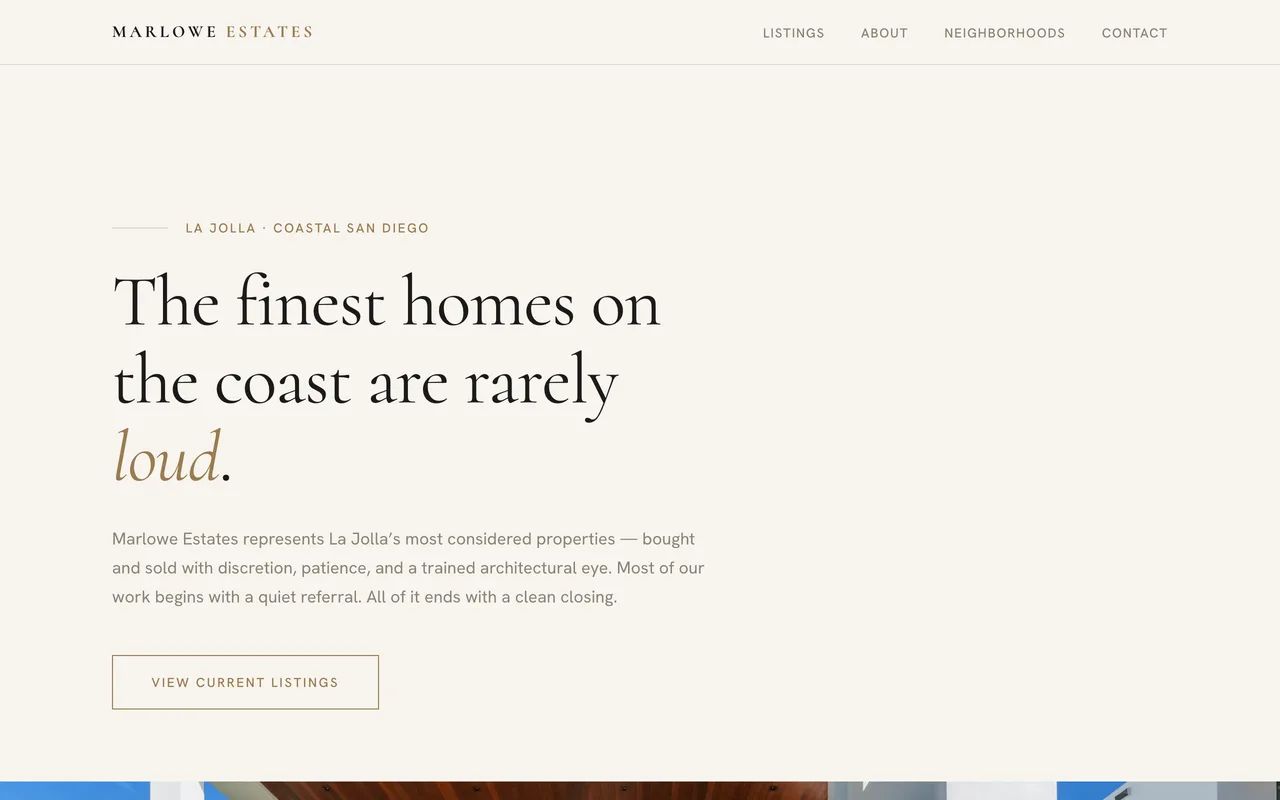
Instead of spending weeks working with a designer or wrestling with WordPress, you can describe your real estate business in plain English and have a complete, professional website generated in under 60 seconds. Listing pages, lead capture forms, an about section, contact information, mobile-responsive design -- all created by AI from your description.

The cost structure has changed dramatically too. FyneSite lets you build and preview your website for free. When you are ready to publish, plans start at $39/month -- a fraction of what a traditional website costs. For agents already spending $200-500/month on lead generation through portals and ads, adding a $39 website that captures organic leads is a straightforward ROI decision.

Updates are equally simple. Sold a listing? Tell the AI to mark it as sold. New property? Describe it and a new listing page appears in seconds. No developer emails. No waiting. No billable hours from a web designer.

What a Good Agent Website Actually Needs

Not every website is created equal. A good real estate agent website in 2026 should include:

  • Professional homepage with your photo, value proposition, and a clear call to action
  • Individual listing pages with photos, property details, pricing, and a contact form on each one
  • About page with your credentials, service areas, and specialties
  • Lead capture on every page -- not just a single contact page buried in the navigation
  • Mobile-responsive design -- 76% of real estate searches happen on mobile devices
  • Local SEO optimization -- your site should rank for "[your city] real estate agent" and similar terms
  • Fast load times -- Google penalizes slow sites, and impatient buyers bounce
  • SSL certificate -- the padlock icon builds trust and is required for modern browsers

The good news: AI website builders handle most of these requirements automatically. You focus on describing your business. The technology handles the technical details.

The Bottom Line

In 2026, the question is no longer whether a real estate agent needs a website. It is how quickly you can get one live.

Every day without a website is a day where potential clients are searching for agents in your area and finding your competitors instead. The buyers who Google "real estate agent in [your city]" are high-intent leads -- they are actively looking for someone to work with. If you do not show up, someone else will.

The barriers that used to justify going without a website -- cost, time, technical complexity -- have been removed by AI. A professional, mobile-optimized, lead-generating website is now accessible to every agent, at every career stage, in under five minutes.

Frequently Asked Questions

Do real estate agents really need their own website?
Yes. 97% of homebuyers start their search online. Agents with their own website generate significantly more leads than those relying solely on brokerage pages or Zillow profiles. Your website is a 24/7 lead generation tool that builds credibility and captures contact information from serious buyers and sellers.
How much does a real estate agent website cost?
Traditional custom websites cost $2,000 to $10,000 upfront plus ongoing maintenance fees. AI website builders like FyneSite let you build and preview a professional agent website for free, with publishing plans starting at $39/month. This makes a professional web presence accessible to agents at any career stage.
What should a real estate agent's website include?
A strong agent website should include a professional homepage with your photo and value proposition, individual listing pages with photos and details, a lead capture form on every page, an About page with credentials and service areas, testimonials from past clients, and mobile-responsive design. IDX integration for MLS search is a strong bonus.
Can I build a real estate website without knowing how to code?
Absolutely. AI website builders generate complete, professional websites from a plain-English description of your business. You describe your brokerage, specialties, and service areas, and the AI creates your site in under 60 seconds. No coding, no design skills, and no hiring a developer.
Is a Zillow profile enough, or do I need my own site?
A Zillow profile is a starting point, but it is not a substitute for your own website. On Zillow, you share space with competing agents and have no control over branding, lead routing, or SEO. Your own website lets you own the relationship with potential clients, rank for local search terms, and present a professional brand that builds trust.

Build yours free in 5 minutes.

Describe your real estate business. AI builds your website. You publish when you are ready. No credit card required.

Free forever plan No credit card Publish in 60 seconds